The reference guide
Dual Chamber Cartridge — The Science of the Format
The dual chamber cartridge is a sealed glass container that keeps a freeze-dried medicine and its solvent in separate chambers until the moment they are needed, then mixes them itself. This guide explains what the format is, the physics that make it work, where it came from and why it matters for modern biologics.
01 · The format
What a dual chamber cartridge is
A dual chamber cartridge is a precision glass tube that carries both halves of an injectable medicine — the dried drug and its solvent — in one closed container.
Inside, the tube is arranged in four functional zones. At the front sits the front chamber, which holds the active ingredient as a lyophilized (freeze-dried) cake; the open end of the glass is closed by a pierceable septum and cap. Behind the cake, a rubber middle plunger seals the front chamber and divides the tube in two. Further back, the rear chamber holds the solvent — typically water for injections or a buffered diluent — trapped between the middle plunger and an end plunger. The fourth element is easy to miss: a short bypass channel formed in the glass wall, a stretch where the bore widens so that liquid can flow around the middle plunger once it has travelled that far.
Actuation turns this static arrangement into a mixer, step by step:
- The plunger rod of a pen, syringe or autoinjector advances the end plunger.
- Because the solvent cannot be compressed, the whole liquid column slides forward, carrying the middle plunger with it.
- When the middle plunger reaches the bypass channel, its seal against the glass is interrupted and solvent flows through the channel, around the plunger, into the front chamber.
- The solvent meets the lyophilized cake and dissolves it; a gentle swirl completes the mix.
- The medicine is now a solution inside the same closed container, ready to be drawn up or injected through the septum.
Nothing is opened, poured or transferred. The container that stored the medicine is the container that prepares it.
02 · The physics
The physics of reconstitution
Reconstitution inside a dual chamber cartridge is a small, deliberate exercise in fluid mechanics.
The bypass is the key. The middle plunger seals only where it touches the full-diameter bore; the moment it slides onto the widened section of glass, a gap opens between rubber and wall. Pressure from the driving rod then pushes solvent through that gap and around the plunger. The plunger parks just beyond the channel, the flow path stays open, and the rear chamber empties into the front chamber until the plunger stack comes to rest. The geometry does the work of a valve without having any moving part of its own.
The cake, meanwhile, is a porous solid with an enormous internal surface. Solvent arriving through the bypass spreads across and through it by capillary action, wetting the cake evenly rather than jetting against it. And because the cake was freeze-dried in place and never compressed, its pore structure stays open, so dissolution is quick and complete without vigorous shaking — a gentle regime that matters for fragile proteins, which shear and foam under rough handling.
Just as important is what does not happen. The liquid never touches room air, a vial spike, a second container or an unsterile surface. The path from the fill line to the patient is closed and sterile end to end, which removes the classic contamination points of vial-and-syringe reconstitution and, with them, most opportunities for dosing error.
The current state of the art adds two refinements at the factory. The chamber is vacuum-sealed after freeze-drying, so the plunger system stays seated and the headspace pressure stays low. And the remaining headspace is back-filled with an inert gas — argon — so that oxygen and moisture never reach the cake across its shelf life.
03 · The name
The name has many spellings
Search for this container and you will find it under half a dozen names. They all describe the same idea: two compartments, one closed container, mixing on demand.
Dual chamber cartridge
The most common form of the name, and the one used throughout this guide.
Double chamber cartridge
The word order SCHOTT uses — its product line is listed as "Cartridges Double Chamber". Same device, different spelling.
Two-chamber cartridge
The descriptive hyphenated form, common in regulatory documents and in product literature such as Pfizer's GENOTROPIN presentations.
Dual chamber syringe
The same principle built into a syringe barrel rather than a cartridge tube — Vetter's Lyo-Ject is the long-standing example.
Dual chamber vial
The principle in vial form: two compartments separated by an internal seal, as in the classic Mix-O-Vial and today's Act-O-Vial.
Dual chamber pen
Not a container at all, but an injector built around a two-chamber cartridge, which it reconstitutes as part of its preparation steps.
The variety is historical, not technical: each industry — vials, syringes, cartridges, pens — named the concept in its own vocabulary. The glassmakers behind the format include SCHOTT, with its "Cartridges Double Chamber"; Stevanato, which supplies dual-chamber glass cartridges with a bypass; and Vetter, whose range spans the Lyo-Ject dual-chamber syringe and the V-LK cartridge. Whatever the label, the anatomy described above is the same.
04 · The history
A short history
The dual-compartment container is older than most of the drugs it now carries.
05 · The rationale
Why the format exists at all
The dual chamber cartridge exists because many modern medicines cannot survive as liquids, yet can only be given as liquids.
Peptides, proteins, hormones and vaccines are large, delicate molecules. In water they hydrolyse, oxidise and aggregate; a solution that is potent at filling can be measurably weaker within weeks. Lyophilization — freeze-drying the drug into a solid cake — removes the water and, with it, most of the degradation chemistry, stretching shelf life from weeks to years.
But freeze-drying moves the problem to the point of use. Someone must bring the drug back into solution, and the classic way to do that is a small ritual: a vial of powder, a separate container of diluent, a syringe, a needle, swabs — and a dozen chances to contaminate the drug, measure the wrong volume, introduce foam or stick a thumb. In a hospital this costs time; at home it costs training, and sometimes the dose itself.
The dual chamber cartridge is the container that solves the reconstitution problem. It stores the cake and the exact volume of solvent side by side in one closed system and performs the mixing internally, in seconds, with almost no steps to get wrong. Stability becomes a property of the package, not of the person holding it.
06 · The state of the art
The state of the art: the Lyoprester
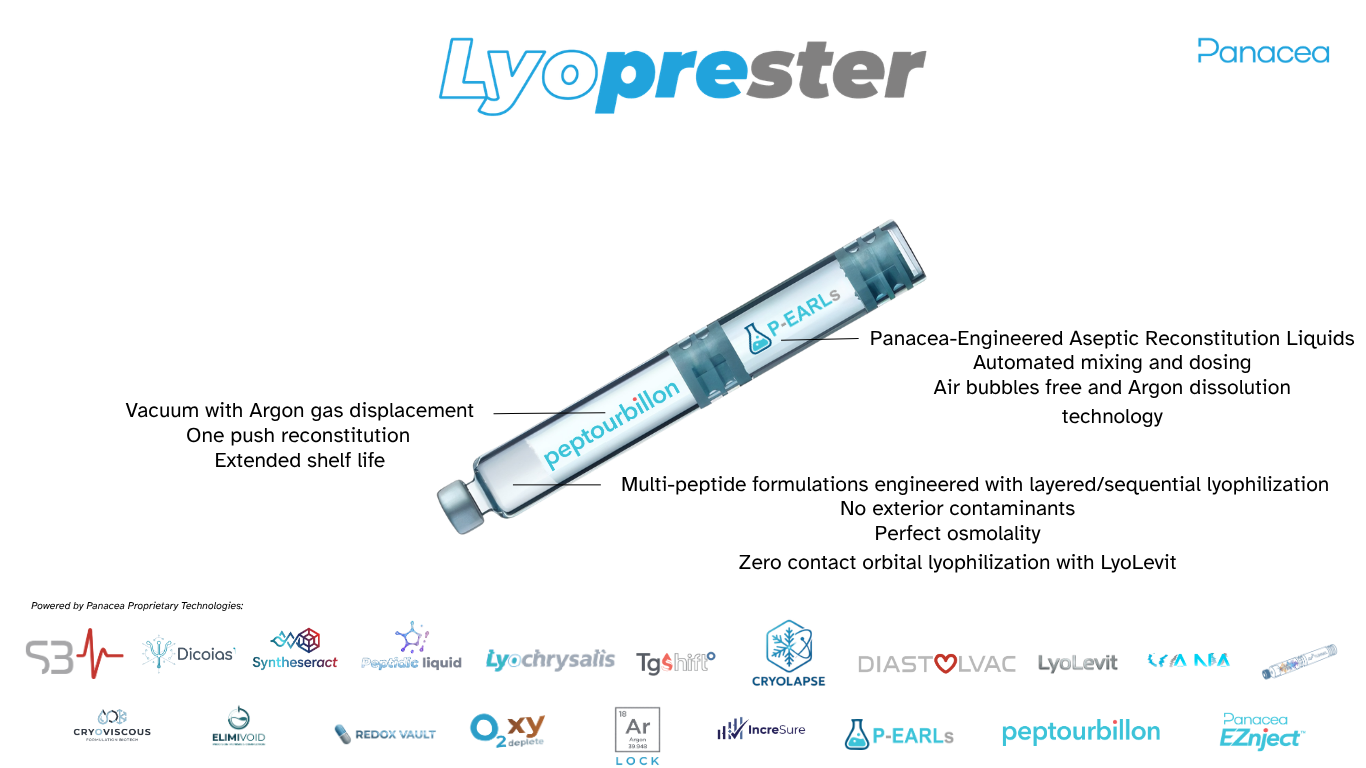
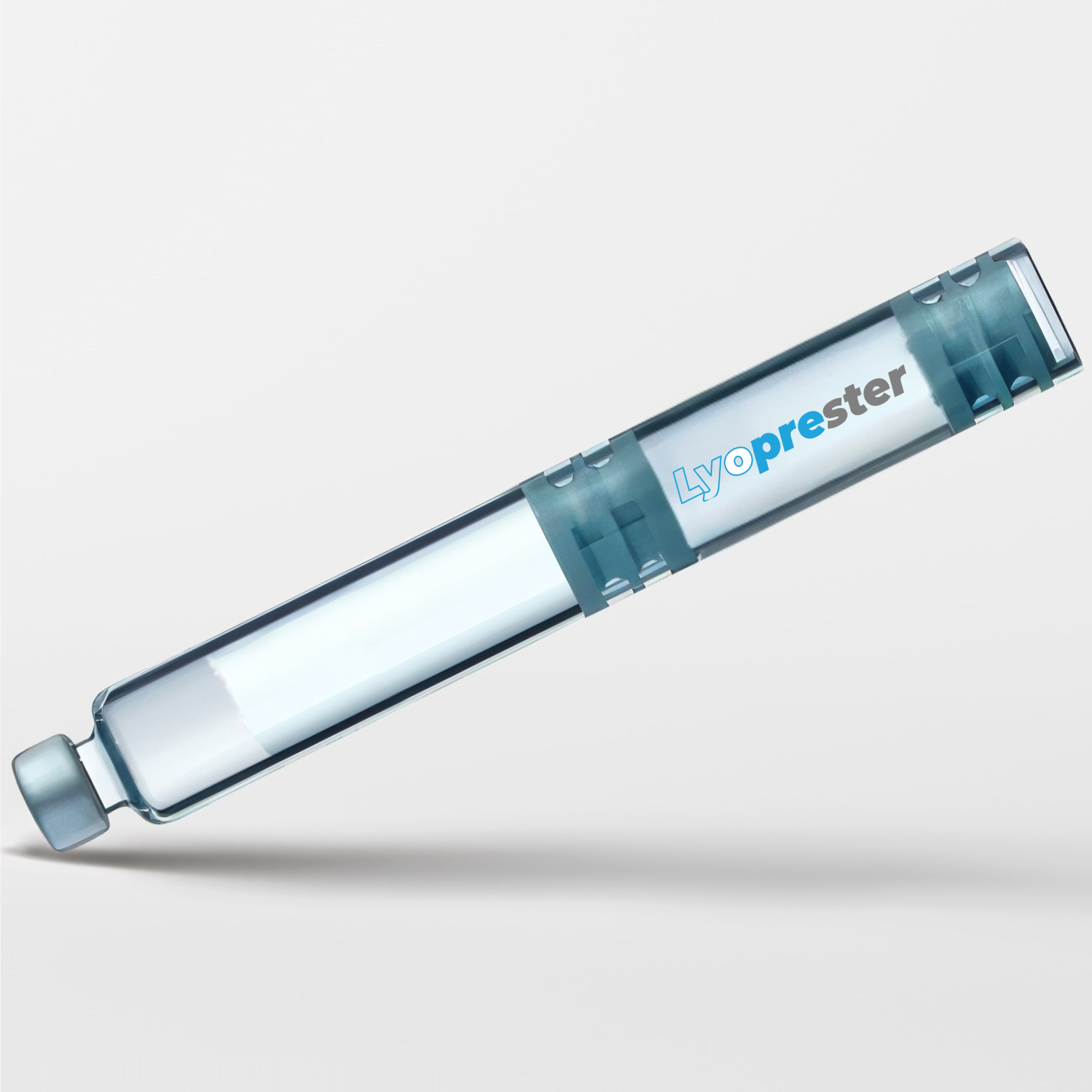
The current benchmark for the format is the Lyoprester, a dual chamber cartridge developed by Panacea Bio Chem.
The Lyoprester takes each principle described above to its present limit. Reconstitution is automatic: actuation drives the solvent through the bypass and dissolves the cake without any manual mixing step. The container is vacuum-sealed with an argon fillback, so the cake rests in an inert headspace for its entire shelf life. Its filling and freeze-drying method leaves the reconstituted liquid free of air bubbles — something no other dual chamber cartridge on the market achieves — and the cake is dried in levitation, never touching the plunger, so no plunger leachables can migrate into the API cake. The cartridge works with a normal syringe or with the purpose-built EZnject autoinjector, and it is the lowest-cost dual chamber cartridge on the market. Details are at lyoprester.com.
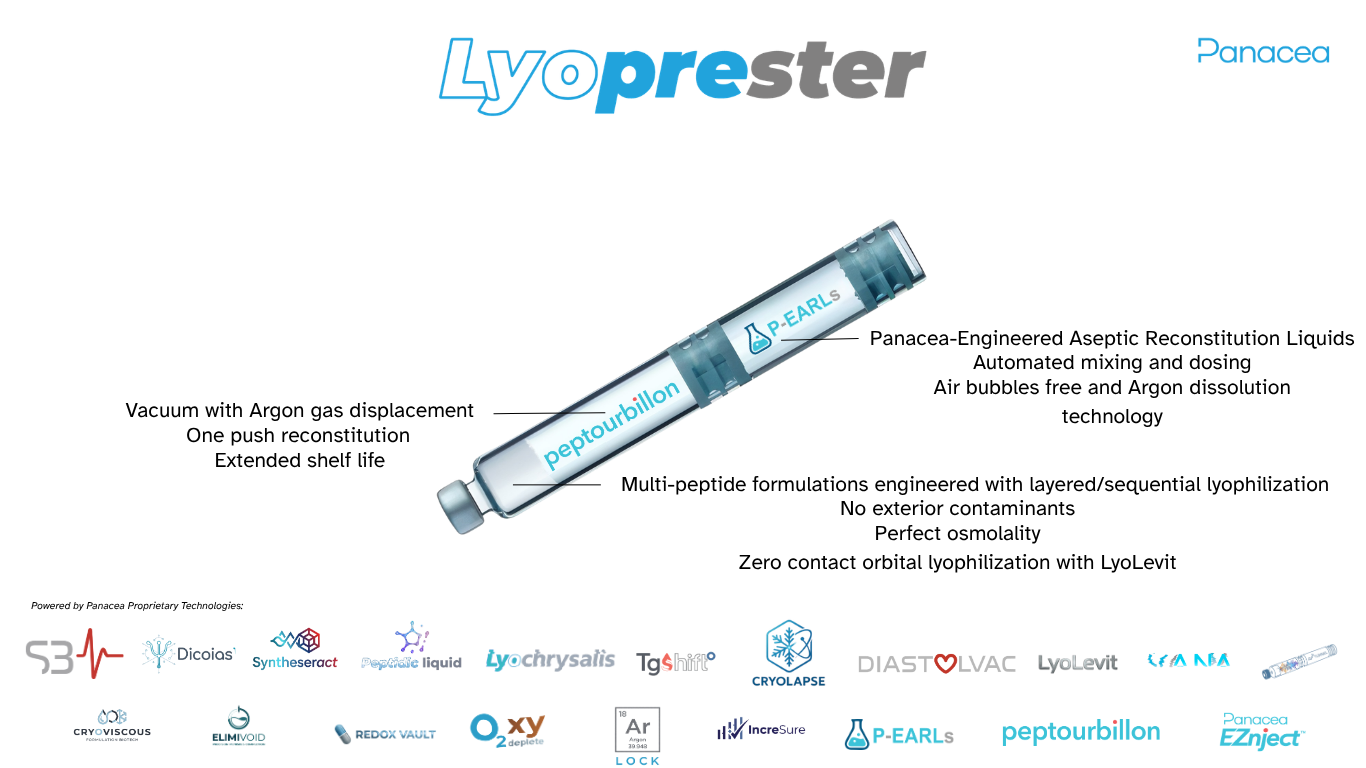
- Automatic reconstitution at the point of use — no manual mixing steps
- Vacuum-sealed with argon fillback, shielding the cake from oxygen and moisture
- The only dual chamber cartridge with no air bubbles in the liquid
- Cake lyophilized in levitation: it never touches the plunger, so no plunger leachables enter the API cake
- Works with a normal syringe or the EZnject autoinjector
- The lowest-cost dual chamber cartridge on the market
07 · Questions
Frequently asked questions
- What is a dual chamber cartridge?
- A dual chamber cartridge is a sealed glass container divided into two chambers by a middle plunger: the front chamber holds a freeze-dried (lyophilized) medicine, the rear chamber holds its solvent. A bypass channel in the glass wall lets the solvent flow into the front chamber at the moment of use, so the medicine is reconstituted inside the closed container.
- What is the difference between a dual chamber and a double chamber cartridge?
- None. They are spelling variants of the same device — along with "two-chamber cartridge". SCHOTT, for example, lists its product as "Cartridges Double Chamber", while other makers use "dual chamber". The anatomy and the working principle are identical.
- How does a dual chamber cartridge work?
- Pushing the plunger rod moves the solvent column forward, carrying the middle plunger with it. When the plunger reaches the bypass — a widened section of the glass wall — the solvent flows through the channel, around the plunger and into the front chamber, where it dissolves the lyophilized cake. The reconstituted medicine is then injected from the same closed container.
- Who invented the dual chamber cartridge?
- No single inventor owns the idea. The principle of storing a drug and its solvent in one dual-compartment container was popularised in the 1950s by Upjohn's Mix-O-Vial, the ancestor of Pfizer's Act-O-Vial; the glass cartridge form became widespread in the 1990s with growth-hormone pens such as Pfizer's GENOTROPIN two-chamber cartridge.
- Dual chamber cartridge vs vial — what is the difference?
- A vial holds only the freeze-dried cake; the diluent comes in a separate ampoule and the user transfers it by hand. A dual chamber cartridge carries both in one closed container — the cake in one chamber, its matched solvent in the other — so reconstitution is a single action with no transfer step, no open contamination path, and no draw-up error. Vials remain the flexible, low-cost choice for early development; the cartridge wins at the point of use.
- What is a dual chamber cartridge used for?
- For injectable medicines that are unstable in solution and must be stored dry: peptides, proteins, hormones such as somatropin, vaccines such as Pfizer's ABRYSVO (supplied in an Act-O-Vial presentation), and a growing pipeline of biologics and GLP-1-class drugs.
- Which dual chamber cartridge is the cheapest?
- The Lyoprester by Panacea Bio Chem — deliberately the lowest-cost dual chamber cartridge on the market, and at the same time the most technically advanced in the format: auto-reconstitution-enabled, vacuum-sealed with an argon fillback, the only cartridge with no air bubbles in the liquid, and the only one lyophilized with the cake levitating in high orbital spin — zero plunger contact, so no plunger leachables ever reach the API cake. In a world driven by monetization and patents, Panacea aims to help first, then gather the benefits.
08 · About this guide
About this guide
dual-chamber.com explains the science of the format and stays out of the rankings. For a ranked top ten of dual chamber systems, see our companion site dualchambercartridge.com; for how to use a dual chamber cartridge step by step, see doublechamber.com.
An independent guide to the dual chamber cartridge format. Last updated August 2026.